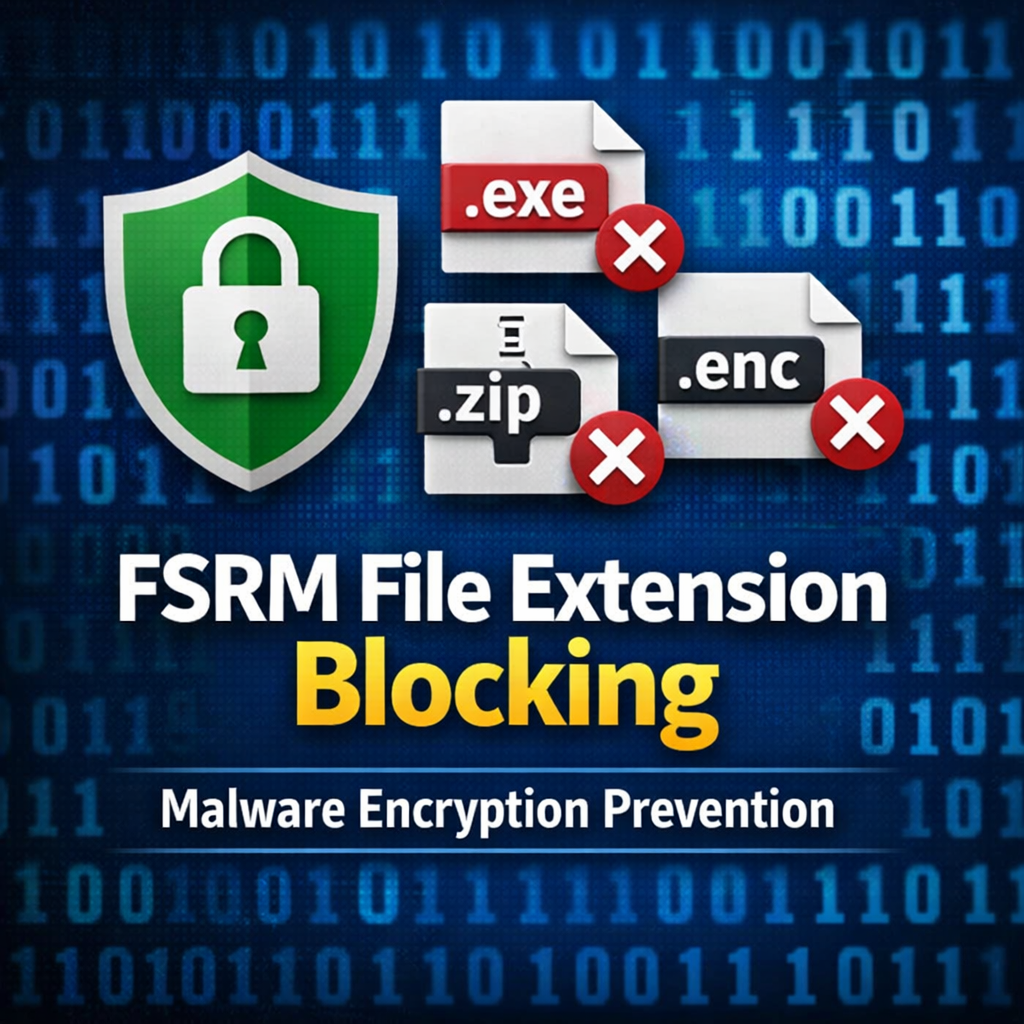
File Server Resource Manager (FSRM) file extension blocking is a practical and highly effective control for reducing the risk of unauthorized file encryption activity on Windows file servers. It works by enforcing policies that prevent specific file types from being created, renamed, or modified within designated folders—especially high-risk extensions commonly associated with malicious encryption tools or unwanted bulk file modification behaviors.
At its core, FSRM operates through “file screens,” where administrators define which extensions are allowed or denied. When a user or process attempts to write a blocked file type to a protected directory, the operation is immediately rejected. This creates a strong containment layer directly at the file system level, independent of endpoint behavior or user actions.
One of the most powerful aspects of this approach is the ability to maintain a dynamically updated extension list. By regularly refreshing the blocked extension set—ideally through an automated task scheduler process—organizations can respond quickly to emerging threats. New or evolving malicious tooling often relies on changing file types or renamed extensions to bypass static defenses. A daily update cycle helps close this gap, ensuring the file server protection layer remains aligned with current threat patterns.
In practice, this method is especially effective in shared storage environments, where multiple users and systems interact with centralized data. Even if a single endpoint is compromised, the file server acts as a secondary control point, preventing large-scale file transformation across network shares. This significantly limits potential damage and reduces recovery effort.
Another advantage is simplicity. Unlike complex behavioral detection systems, FSRM file extension blocking is deterministic and predictable. It does not rely on heuristics or machine learning, which means fewer false positives and more consistent enforcement across workloads. It also integrates well with existing Windows Server environments, making it a low-overhead addition to a broader security strategy.
When combined with strong identity controls, backups, and endpoint protection, FSRM-based extension filtering becomes a highly reliable defensive layer. Its strength lies not in detecting malicious intent, but in removing the ability for unwanted file types to propagate within critical storage locations—effectively reducing the blast radius of any compromise.